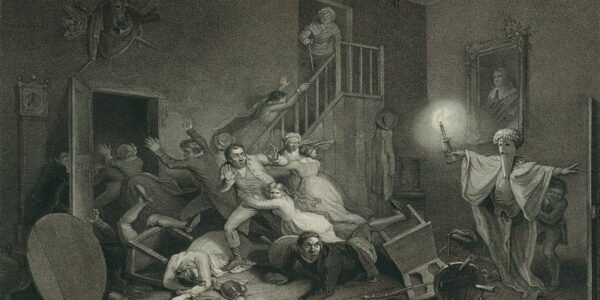
For most, Christmas conjures images of twinkling lights, festive cheer, and family gatherings, yet, arguably since the pre-Christian era, and certainly since the Victorian era, it has also harboured a darker, more mysterious side, steeped in shadows and whispers. The tradition of sharing ghost stories during Christmas is a fascinating relic of a time when winter nights stretched out, and the veil between the living and the dead was believed to be tantalizingly thin (Ehnes, 2012).
From Victorian firesides to modern media, the Christmas ghost story has endured, captivating audiences with its eerie blend of the supernatural and the sentimental. This post, briefly, explores the origins of this peculiar tradition and its resonance during the festive season.
A Historical Perspective on Christmas Ghost Stories
The association between ghost stories and Christmas, most likely, predates the Victorian era, rooted in the customs of long, dark and cold winters nights. Before modern conveniences like electric lights, the season’s darkness created a natural setting for tales of the unknown. In medieval Europe, storytelling, particularly of a supernatural kind, was a common winter pastime (Grider, 1999).
The Victorian period, however, saw the flourishing of this tradition in popular culture, epitomized by Charles Dickens’ A Christmas Carol. Dickens’ fascination with the supernatural, shaped by his childhood experiences and cultural milieu, imbued his work with a unique blend of Gothic and moral themes (Chakraborty, 2012). Dickens did not invent the concept of Christmas ghost stories, but his works cemented their place in public imagination by intertwining festive warmth with spectral chills (Ehnes, 2012).
The Appeal of Ghost Stories at Christmas
Ghost stories resonate with the dual nature of Christmas: a time of joy and renewal coinciding with the year’s darkest days. This duality reflects themes of life, death, and redemption. The stories offer us a focus for moral lessons through chilling narratives (Ehnes, 2012).
For instance, Dickens’ A Christmas Carol portrays the ghosts of Christmas Past, Present, and Future as agents of self-reflection and transformation. Such stories blend supernatural elements with ethical instruction and encourage audiences to consider their actions and values during a season of giving (Chakraborty, 2012) offering us the chance to emerge from the Christmas season as, potentially, better people!
Victorian Christmas and the Supernatural
The Victorian era transformed the ghost story into a seasonal tradition, aligning it with Christmas markets and cultural practices. Publications of the time, like Household Words, popularized ghost stories as festive entertainment, the stories served as a tool to explore social issues and reaffirm Christian values amidst the secularization of modernity (Ehnes, 2012).
Authors like Elizabeth Gaskell and M.R. James contributed to this tradition, crafting tales that balanced eerie suspense with moral underpinnings. The Victorian Christmas ghost story served as both entertainment and a medium for cultural commentary, addressing the social and spiritual anxieties of the age (Ehnes, 2012).
Christmas Ghost Stories Around the World
While Victorian England popularized the Christmas ghost story, similar traditions exist globally. In Scandinavia, the Julenisse, a mischievous yet ghostly figure, visits homes during Christmas, blending folklore with the supernatural. Germany’s Twelve Days of Christmas feature tales of spirits and demons, often serving as moral instruction (Newall, 1987).
These cultural variations highlight the universal appeal of ghost stories during the winter season, each tradition reflecting local beliefs and values.
Modern Revivals of Christmas Ghost Stories
The 20th century saw a decline in the Christmas ghost story, yet their value to us as a culture seems not to have entirely been forgotten and recent years have witnessed its resurgence. The BBC’s adaptations of M.R. James’ works and the growing popularity of podcasts and audiobooks featuring ghostly holiday tales demonstrate the genre’s enduring charm (Ehnes, 2012).
These modern interpretations retain the moral and reflective qualities of their Victorian predecessors while adapting to contemporary media and audiences, demonstrating the versatility of ghosts as a storytelling medium.
The Unique Power of Ghost Stories at Christmas
Christmas ghost stories do more than entertain; they work to bridge the gap between the living and the dead, between our collective past and present. These tales evoke universal emotions such as regret, and the hope for a brighter future, adding depth to our holiday experience (Grider, 1999).
By juxtaposing the spectral with the festive, ghost stories can offer a counterbalance to the season’s commercial brightness and remind us of life’s fragility and the enduring power of memory and love, these things would not be out of place or without immense value when exercised against the backdrop of our contemporary world.
Conclusion
From Dickens to modern media, Christmas ghost stories remain a compelling tradition. They invite us to reflect on our past, honor our memories, and embrace the full spectrum of human emotion during the holiday season. As you gather this Christmas, to celebrate with friends and family, before collapsing in a heap on the sofa to digest your Christmas Dinner, perhaps there might be a little room for a ghostly tale or two?
References
Chakraborty, S. (2012). Dickens and the Supernatural. Rupkatha Journal on Interdisciplinary Studies in Humanities, 4(1), 59–62. Available at: http://rupkatha.com/V4/n1/06_Dickens_and_the_Supernatural.pdf
Ehnes, C. (2012). Winter Stories—Ghost Stories… Round the Christmas Fire: Victorian Ghost Stories and the Christmas Market. Illumine, 11(1), 6–9.
Grider, S. (1999). The Haunted House in Literature, Popular Culture, and Tradition: A Consistent Image. Contemporary Legend, 2, 174–180.
Newall, V. J. (1987). The Adaptation of Folklore and Tradition. Folklore, 98(2), 131–151.