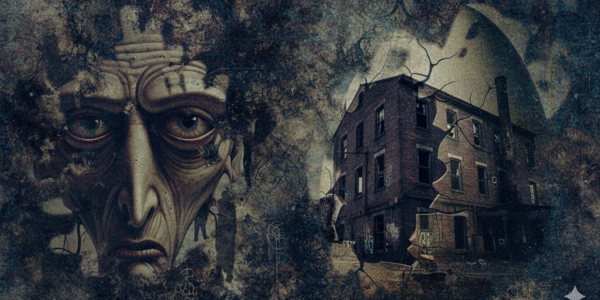
The quietest hauntings are often the most frightening. Think about those familiar, domestic moments: the sudden, inexplicable cold spot in a warm room, the drawer that always sticks, or the faint scent of a perfume or tobacco no one currently wears. These aren’t grand ghost stories or epic mythological cycles. They’re the small, persistent echoes of the past we find everywhere, in the architecture of the everyday. Local legends, domestic uncanniness, and ambient traces remain one of our vital cultural resources, and they quietly shape the atmospheres, mechanics, and emotional rhythms of contemporary game design. The way I see it, the challenge for the 21st-century developer isn’t to invent a whole new world, but to learn how to listen to the one already there.
The Resonance of Residue
As a games design academic, I work where folklore, digital heritage, and hauntology overlap. Hauntology isn’t simply the study of ghosts; it’s the analysis of how the past (in the form of technologies, social norms, or cultural ideas that refuse to pass away) continues to structure our present. When I’m thinking about worldbuilding for games, this approach means shifting focus from spectacular monsters to the significant residue. Folklore, seen in this context, is the collective history of a place: the ghost stories, certainly, but also the peoples’ slang, the local traditions of mourning, the memory of an abandoned factory, or the way a British terraced house ‘remembers’ the shape of a family who lived there a century ago—something I call the Domestic Wyrd. This concept of the domestic uncanny is profoundly rich. It’s the feeling that the mundane objects around you are quietly observing a history you do not know.
Weaving the Trace: Layers of Interactive Design
The power of this folklore lies in its ability to ground a world in reality while, at the same time, injecting a deep psychological tension. It can influence every layer of interactive design:
Environmental Storytelling: Place vs. Space
A grand cathedral is merely a space. Contrast that with a rusting boiler house on the forgotten edges of a town, its metal surfaces scratched with unreadable graffiti. That is a place. The folklore of this place provides the environmental storytelling, the texture, the wear, the evidence of human action—that is what makes a location resonant.
Interactive Mechanics & Persistence
Quiet hauntings can be translated directly into subtle interactive systems. A ‘haunted’ object might not animate and attack; instead, it might subtly alter the environment: a lightbulb that blinks out only when the player enters a specific corner of a room, or a locked door that only opens to a rhythmic input mimicking a long-dead person’s knock. The mechanics are not about confrontation, but persistence.
Player Psychology: Sustained Dread
I prefer games that avoid sensationalised belief, preferring instead to leverage the player’s deep cultural literacy about homes and histories. The fear, anxiety, or haunting arises not from what you see, but from what the setting implies. It is an act of gentle, sustained dread.
Ethics of Representation: Honouring the Trace
When we interpret folklore and heritage, the ethics of representation demand respect. By focusing on the residual atmosphere—the quiet trace—rather than sensationalizing local tragedies, we acknowledge the intangible heritage of a place. We are interpreting, not appropriating.

Design Reflection:
My own practice-based research adopts an interpretive framework where the act of making becomes a way to explore these lingering traces. I deliberately seek out the overlooked corners of post-industrial British landscapes, using 3D scanning and photogrammetry to create high-fidelity, material records of what is fading. This process transforms physical residue into digital heritage. The resulting assets, like those from my Short Street project or my experiments in the Godot engine, are not just models; they are containers for memory. Similarly, my digital poppets are a form of reflective making, small interactive artifacts that embody a single trace of local folklore. They are a means of understanding how small, hand-crafted, or materially-attentive interactive objects can carry the affective weight of a whole world. This practice grounds the academic theory in the palpable reality of a digital space, ensuring that the work remains confident, reflective, and deeply grounded in the craft of game development. We design not for the worlds we invent, but for the worlds we inhabit, and the silent, patient stories they are waiting to tell. Perhaps your next great monster isn’t a demon at all, but the unsettling memory lodged deep within the foundations of a forgotten house.