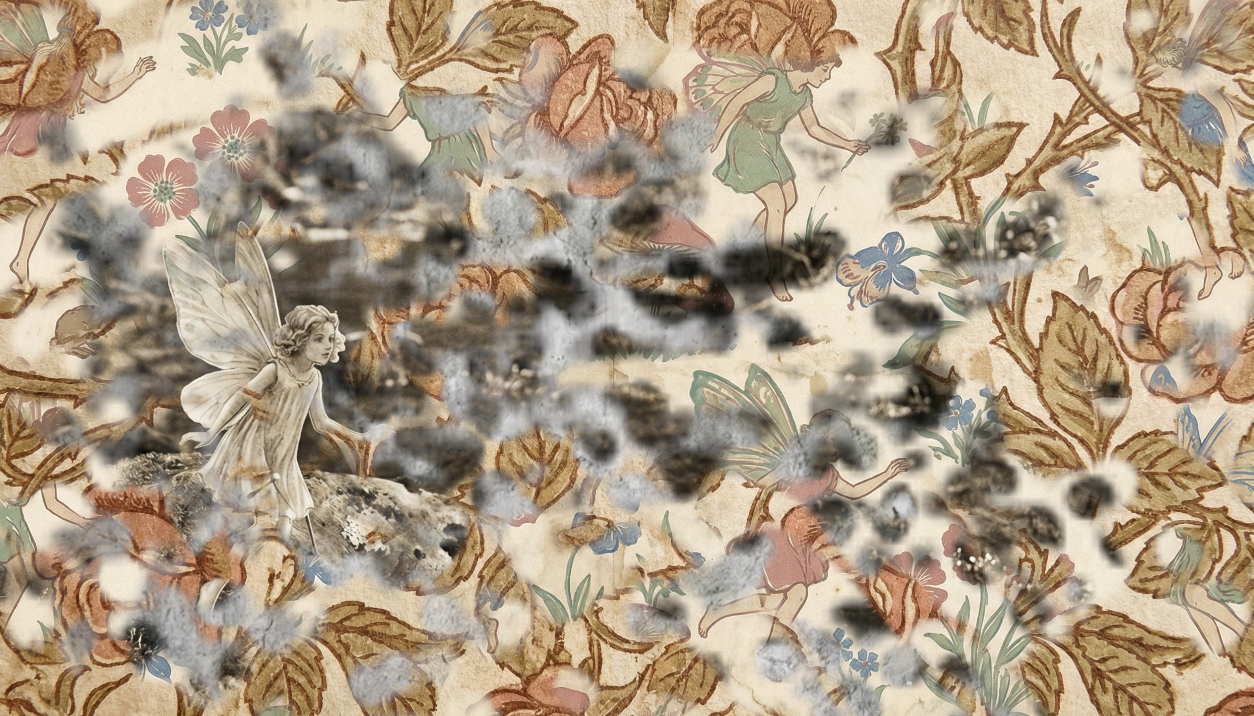
Recently I have been thinking about the concept of Digital Hauntology. Much of my work starts in the same place: a scan of a handmade artefact brought into a digital environment. This is a wonderful way to work; it allows me to create characters by hand that I can give some form of ‘life’ to in the virtual environment.

In the beginning, though, I often created a 3D scan and felt unnerved by the chaos of the wireframe. More often than not, it is a jagged mess of triangles that defies the logic of the grid.
Many of my colleagues, who are talented 3D artists, would look at this mess and instinctively want to clean it. They would be right to do so, of course. Their job is to create “life.” They build characters that move fluidly and breathe convincingly. To do that, they need order.
My work takes me down another path. My goal isn’t to create life… it’s to simulate the afterlife. And in the afterlife, things are not clean.
It forces me to ask: why do we instinctively treat ‘clean’ as inherently better? And how can we turn technical imperfection into a narrative weapon? Personally, I veer away from the desire for a ‘clean’ mesh. I don’t spend my time working for clean loops. Instead, my goal is to build entities that feel like they have been torn from the earth.
The Archaeology of the Glitch: A Foundation for Digital Hauntology
In my early career, I trained as an archaeologist. The thing that attracted me to that world was the secrets that hide in the fractured remains of the past.
In the games industry, though, we worship the god of optimization for very good reason: Players seek immersion. So, we treat the polygon count like a budget and the texture seam like a sin.
But for the Techno-Folklorist practicing Digital Hauntology, that “noise” isn’t garbage. It is data: the fractured, haunted remains of what might have been and what could be again. In digital heritage, this is known as Paradata.
The London Charter (2009) defines it as the evidence of interpretation. When I scan a handmade poppet, the stray fibres, irregular stitches, or poorly scanned sculptural components are the “paradata”. They are the fingerprints of the maker.
Retopologising a raw scan is necessary for many artists, but in my work, it is an act of erasure. By smoothing out the hesitation of the human hand, we risk turning a haunted object into a plastic asset.
Of course, I reduce the poly count (we must compromise to ensure the game runs), but I refuse to fix the flow. I preserve the glitch because I am preserving the evidence that I was there; that my own touch lingers in its geometry.
Horror Game Design Takeaway: Know why you are optimizing. If your goal is smooth realism, clean your mesh. If your goal is preservation and hauntology, let the “noise” remain.
Agency Over Aesthetics
The friction between Artist and Designer is often about control versus behavior. A professionally retopologized model is a miracle of control. It is obedient. It bends exactly where the rigger tells it to.
My decimated, uncleaned work is, in its own way, disobedient. When you apply standard animation to a chaotic, triangulated mesh, it doesn’t bend smoothly… it crunches and it tears. The geometry fights the rig rather than yielding to it.
Maldon (2025) describes this as the “Fear of Intruding Agency”: the anxiety that the glitch is not a mistake, but a manifestation of a will that opposes the code.
By refusing to clean the topology, I am not just building an asset; I am birthing a Wyrdling. I am designing a creature that pushes against what the engine wants it to be. It stops looking like a predictable NPC and starts acting like a captured species.
Horror Game Design Takeaway: Design behaviors, not just surfaces. Use “bad” topology intentionally to create animations that feel unnatural and resistant. Make the player feel like the entity is fighting the software.
Digital Hauntology and the Rotting Mesh
When Fisher talks about Hauntology, he describes the persistence of the past; the “lost futures” that haunt the present. A clean, polished mesh carries the sheen of futuristic perfection.
A decimated mesh takes on a rotted, collapsing quality. The jagged edges and collapsed vertices act as a form of digital entropy. They visualize the idea that the folklore is old, degrading, and barely holding together… a visual language unique to Digital Hauntology..
In the same way that a warped VHS tape feels more “haunted” than a 4K stream, a broken mesh carries the weight of time. It has what scholars call digital materiality. This is a heaviness that burdens the GPU and the player alike, creating a distinct Uncanny Affect.
Horror Game Design Takeaway: Use decimation as a texture of decay. Let the geometry reflect the disintegration of the folklore you are preserving.
Conclusion: The Mesh That Fights Back
We have all played games where the monsters look too perfect, too shiny, too made. They don’t scare us because we can see the logic of their construction.
For me, real horror comes from the “wrongness” of a thing. It comes from the seam where the texture fails, the spikey vertex, or the silence of a room that feels like it’s watching you.
So, in my work, I keep those stray vertices where they are. I let the seams show. This commitment to imperfection is the essence of Digital Hauntology. Because a ghost shouldn’t gleam like a finished character; it should glitch like a mistake.
References
- Beacham, R. C. (2012). Concerning the paradox of paradata. Virtual Archaeology Review.
- Fisher, M. (2014). Ghosts of My Life: Writings on Depression, Hauntology and Lost Futures. Zero Books.
- London Charter. (2009). The London Charter for the Computer-based Visualisation of Cultural Heritage.
- Maldon, A. (2025). Wrongness Done Right: Conceptualization of Horror Experience Caused by Glitches. TH Köln.