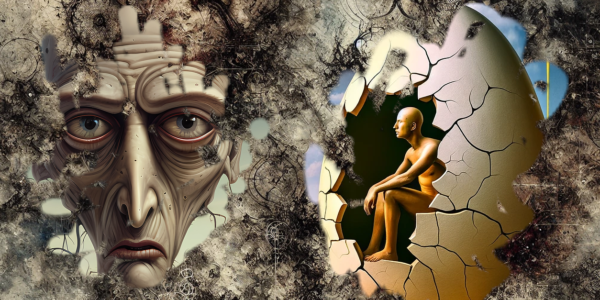
Surrealism, an avant-garde movement emerging in the early 20th century, sought to unlock the creative potential of the unconscious mind by juxtaposing irrational images and concepts (Gürelli, 2022). While its initial applications were predominantly found in literature and visual arts, surrealism’s influence has permeated various media, including cinema and video games. In horror games, surrealism serves as a critical tool for crafting unsettling, intellectually stimulating experiences that plunge players into distorted realities where the boundaries between dreams and nightmares blur. By incorporating fragmented narratives, supernatural elements, and the natural human fear of the unknown, surreal horror games can captivate players and evoke a lingering existential dread.
The Convergence of Surrealism and Horror in Video Games
The fusion of surrealism and horror is a natural one,they have a common goal to destabilise the familiar and challenge our perceptions. Surrealism delves into the unconscious, crafting imagery and scenarios that defy our logical explanation, while horror thrives on inducing discomfort and fear through the unfamiliar. Together, they can create a potent combination that compels players to confront abstract fears rooted in existential questions. This marrage is particularly effective in video games, where players are active participants.
The use of surrealism in cinema, such as Kyle Edward Ball’s Skinamarink (2022), provides a great foundation and inspiration for creating unease by combining disjointed imagery with unresolved tensions. Similarly, David Lynch’s Eraserhead (1977) employs surrealist techniques to evoke a sense of unease and disorientation. However, the interactive nature of gaming further amplifies this surreal horror experience, requiring players to navigate fragmented worlds and decipher cryptic narratives, making the surreal elements feel deeply personal (Sérié, 2021).
Transforming Dreams into Nightmares through Surrealism
Dreams and nightmares have always been central to surrealist art. In horror games, these dreamlike elements are distorted and exaggerated to create a haunting atmosphere. We can see this unsettling use of dream logic in a personal favourite film, Skinamarink (Ball, 2022), where spaces shift and boundaries collapse and in movies like Eraserhead (Lynch, 1977), which presents a nightmarish industrial landscape. In games such as Pathologic 2 which immerse players in a plague-ridden town where time, space, and logic are warped to mirror the protagonist’s psychological stress, Nightmarish sequences blend with the waking world, blurring the line between reality and illusion, thereby enhancing the horror and underscoring themes of disease, mortality, and human fragility (Stephens, 2020).
Fragmented Memories and Narrative Disorientation
Horror games often employ fragmented narratives to immerse players in disjointed and unsettling experiences. This narrative disorientation finds cinematic parallels, again, in films like Skinamarink (Ball, 2022), which eschews traditional storytelling in favor of fragmented visuals and eerie soundscapes. Similarly, Mulholland Drive (Lynch, 2001) presents a non-linear narrative that challenges viewers’ perceptions of reality. In gaming, Observer delves into fragmented psyches, with players assuming the role of a neural detective exploring chaotic, glitching sequences filled with symbolic imagery. This disorientation reflects the characters’ psychological struggles, making the horror feel both personal and deeply unsettling (Gunning, 2018).
Supernatural Elements in Surreal Horror
Surrealist horror games often feature supernatural elements that defy explanation, introducing impossible environments and phenomena that exist outside the boundaries of reality.For example, Control by Remedy Entertainment embraces surrealism to create a mind-bending experience. As players explore the mysterious Federal Bureau of Control, they encounter shifting architecture and abstract enemies, creating a supernatural dreamscape where the rules of physics and logic are in constant flux. This design amplifies the horror, as players can never fully trust their surroundings (Remedy Entertainment, 2019).
The Uncanny in Surreal Horror Games
One of the most effective tools in surreal horror is the uncanny, elements that are familiar yet disturbingly off. This concept, rooted in Sigmund Freud’s psychoanalytic theory, is a hallmark of surrealism. In horror games, the uncanny manifests through distorted environments and human-like creatures with grotesque features. Little Nightmares exemplifies this technique by presenting a world that feels vaguely familiar yet disturbingly distorted, creating a lingering sense of discomfort and forcing players to question the nature of the world they’re exploring (Bandai Namco Entertainment, 2017). Similarly, in the world of film, Blue Velvet (Lynch, 1986) uncovers the sinister underbelly of American suburbia, presenting familiar settings that are tainted with darkness and perversion.
Visual and Auditory Design in Surreal Horror
Visual and audio design are crucial in creating the surreal atmosphere of horror games. Developers use abstract and nonsensical imagery, paired with distorted or minimalistic soundscapes, to immerse players in a world that feels otherworldly. To refer, once again to a personal favourite, the experimental audio-visual techniques of Skinamarink (Ball, 2022), including its use of distorted ambient sounds and minimal visual cues, parallel how games like Oxenfree use saturated colors and eerie soundscapes to create unsettling experiences. Similarly, Eraserhead (Lynch, 1977) employs an industrial soundscape and stark black-and-white visuals to create a nightmarish atmosphere. These techniques transport viewers and players alike into a surreal, dreamlike state that enhances the horror (Night School Studio, 2016).
Existential Dread in Surreal Horror Games
Surreal horror compels players to confront deeper, existential fears, often exploring themes of identity, mortality, and the nature of reality. By presenting players with fragmented narratives and abstract imagery, Surreal Horror Games encourage introspection and self-reflection, creating an experience that lingers long after the game ends. What Remains of Edith Finch, for example, is a narrative exploration game with surreal elements which has players relive the memories of a family cursed by tragedy. Each family member’s story is told through a unique, dreamlike sequence, blending surreal visuals with poignant storytelling, thereby amplifying its exploration of mortality and leaving players to ponder the fragility of life and the inevitability of death (Giant Sparrow, 2017).
Conclusion
Surrealism has proven to be a timeless and versatile technique within films, literature, music and horror games. By blending fragmented narratives, dreamlike atmospheres, and supernatural ambiguity, surreal horror games push the boundaries of what the medium can achieve. The influence of surrealist films, such as Skinamarink and David Lynch’s works, underscores the capacity of surrealism to evoke deep-seated discomfort and existential reflection. Video games amplify these effects through their interactive nature, immersing players in personal and disorienting experiences that transcend traditional storytelling. As designers continue to explore the interplay of surrealism and horror, the genre promises to remain a fertile ground for innovative and thought-provoking creations that resonate with audiences long after they finish playing.
References
Bandai Namco Entertainment. (2017). Little Nightmares [Video game].
Ball, K. E. (Director). (2022). Skinamarink [Film].
Freud, S. (1919). The uncanny. Imago, 5(1), 1-21.
Giant Sparrow. (2017). What Remains of Edith Finch [Video game].
Gürelli, I. (2022). The impact of surrealism on modern digital art. Art Journal of Postmodern Media Studies, 34(1), 45–59.
Gunning, D. (2018). Fragmented narratives in cyberpunk horror: An analysis of Observer. Interactive Media Review, 12(3), 101–120.
Lynch, D. (Director). (1977). Eraserhead [Film].
Lynch, D. (Director). (1986). Blue Velvet [Film].
Lynch, D. (Director). (2001). Mulholland Drive [Film].
Night School Studio. (2016). Oxenfree [Video game].
Playdead. (2010). LIMBO [Video game].
Remedy Entertainment. (2019). Control [Video game].