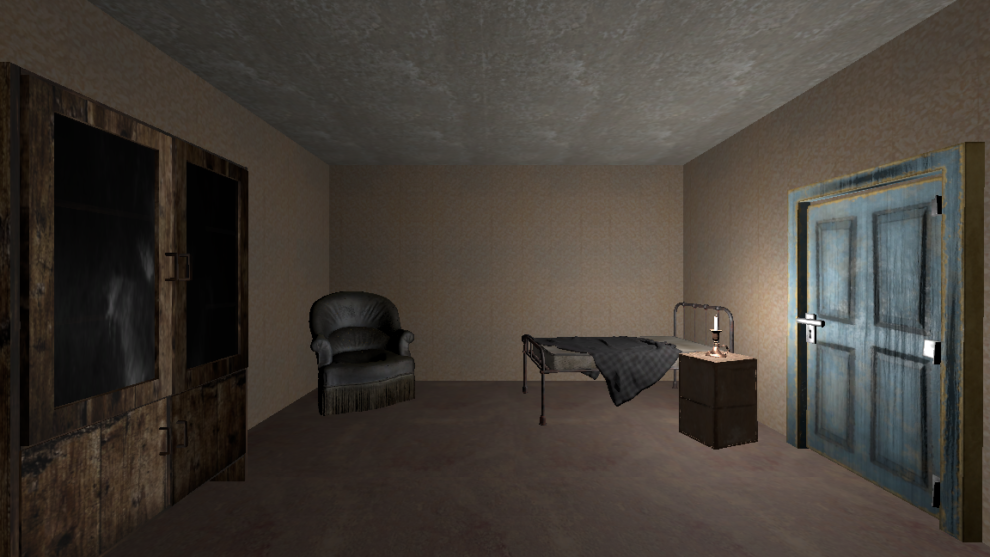
This week I am thinking about Environmental storytelling in game design and I’m going to start with a seemingly silly question, can a room still feel occupied even when no one is in it? It is, I think, quite normal for game designers to fall into the trap of obsessing over character arcs and scripted events, but some of the most profound narratives are often told through the walls themselves. To explore this, I recently conducted an “Empty Room” experiment to see just how much meaning a 3D environment can communicate when you strip away the actors and the action. What I found taught me a lot about the concept of implied presence.
The Experiment: Stripping Back the Narrative
The idea and setup were deliberately simple. I used the Godot engine to construct a small, domestic bedroom. I intentionally chose models from Fab.com that had a slightly worn feel to them, but there were no characters, no dialogue, and no quests.
The scene was set up without much concern for artistry. Godot isn’t great at photorealism anyway (or at least I am not) but that actually fit with my intentions. Despite the models, I needed the space to feel deliberately synthetic. Using the fixed camera, I thought, strips away the expected dynamism, forcing focus onto a quiet inventory of mundane. An armchair, a bed with a candle beside it, a cupboard. Just these ordinary objects, punctuated by a single closed door. My main goal was to see if removing explicit narrative information would result in a space that felt truly “empty.”
From Empty to Unoccupied: The Magic of Implied Presence
The results were not as I expected. The room didn’t feel empty at all; it felt unoccupied. Despite my god-awful, lackluster modelling, environmental storytelling had taken over. Despite there being no character in the scene, the objects I had placed there seemed to tell me about their existence through their absence. The bed, in its unkempt state, implied someone had been there not too long ago, and even the closed cupboard hinted that the person, who was rapidly becoming a solid form in my mind’s eye, had hidden possessions… for some reason, the thought of a human with ‘things of their own’, to me at least, conjured up a living breathing person, perhaps just gone next door for a few moments and who might, at any moment emerge through the closed door. Each object acted as a marker for a person, a person who you can easily imagine, proving that narrative design doesn’t always need a face to tell a story.
Composition and Expectation in 3D Environments
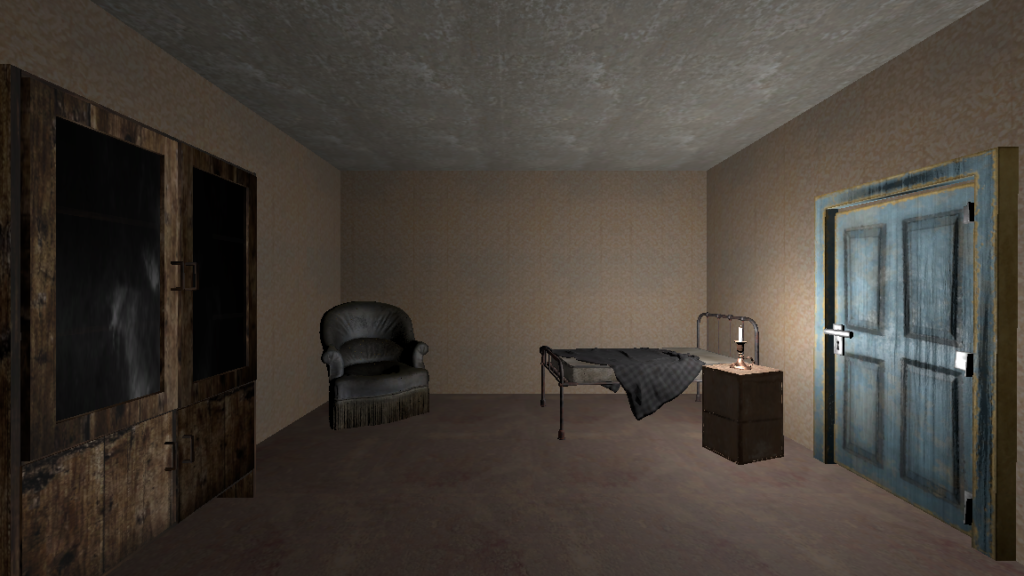
I think the way the 3D environment was presented played an important role in the perception of the absent inhabitant. By using a fixed viewpoint, the room felt like a stage. To the right, a bedside candle cast a strong glow, making a blue door the visual focal point. To the left, the cupboard sat in shadow, creating a sense of mystery. This contrast between light and dark naturally guides a player’s attention and creates expectations about the world beyond the frame, almost daring the player to explore further.
The Mystery of the Closed Door
One of the most powerful tools in this experiment was the closed door. In game design, a door is rarely just a door; it’s an invitation to the unknown. The presence of a door immediately suggests that the visible space is incomplete, encouraging the mind to imagine what lies on the other side. By controlling what is visible and what is obscured, we can create a palpable sense of unseen space, heightening the tension and engagement for the player.
Why This Matters for Game Designers
The “Empty Room” experiment suggests that absence is a loud and effective storytelling device. When a space contains recognizable props (a bed, a chair), it becomes impossible to make it truly meaningless. Instead, the character becomes unavoidable through their absence, making them a feature of the space even though they are not there. For designers, this is a powerful starting point: by mastering environmental composition and visibility, you can lead players to infer complex entities and events without ever showing them a single pixel of a character model.
A Problem with the Experiment
Some of the more astute readers will have spotted, already, the obvious problem with my experiment: the room was never truly neutral. The worn furniture, uneven lighting, dark cupboard and closed door that I chose, already push the environment towards something slightly uncanny. Therefore, I may have accidentally designed some of the mystery in that I later observed. A useful follow-up would be to repeat the experiment with a much more neutral room and gradually remove or alter individual objects to see when that sense of implied presence begins to disappear.