Through my recent work in supernatural horror game design, it has increasingly become apparent to me that, if translating the supernatural into real, tangible, game experiences is my goal as a game design academic, there is a need to re-immerse myself in the tools, the code, the magical language if you like, of what makes compelling game design possible.
So, what drives an academic back to the beginning? Why should I abandon the comfort of competency to stare once more into the arcane heart of code? And if I listen closely enough, can programming begin to feel like summoning?
As a game design lecturer who has found their focus in navigating virtual haunted spaces, glitching liminal corridors, and digital phantoms, I have found myself realising that I need to return to the deepest roots of my technical craft. It’s not out of necessity, but out of a deep urge to revisit the foundations from a new angle shaped by a desire to revolutionize supernatural horror environments within digital space. This is not an attempt to relearn. It is more than that, almost, ritual.
Midnight at the Crossroads
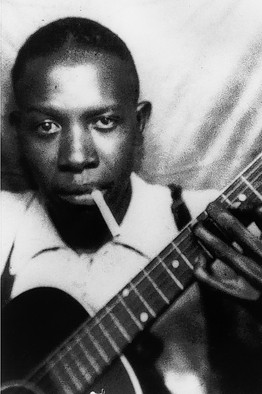
As I write this blog post, I have the music of legendary bluesman, Robert Johnson, playing in the background. Music, I find, defines us so much, shaping who we are and even our view on the world. On the whole, my preferred music is the pop-punk of the 90s and 00s but the blues also has a special place in my heart, particularly the haunting blues music of the legendary Robert Johnson who is said, in the early 1900s, to have walked to a rural crossroads at midnight and traded his soul with the devil for a level of talent that defied human understanding. Folklorists have pointed out that Johnson’s myth didn’t emerge in his lifetime but grew over time and was cross-pollinated by hoodoo traditions, Christian cautionary tales, and the historical power of liminal spaces (De Vos, 2011). But regardless of your belief in the legend, the crossroads myth persists because it captures something real. It reminds us, that talent, when pushed to its edges, begins to look mystical.
This spring, I’m undertaking my own version of that passage.
For the next 80 days, I will descend into some of the foundational languages and systems that shape how we make games: C++, Unreal Engine, Blueprints, GDScript, and C#. I will spend time, every day, writing, debugging, reflecting, and creating. Not in an attempt to reclaim knowledge lost, but to re-encounter it through immersion, repetition and new perspectives. I will start at the very beginning, the almost legendary in itself ‘Hello World’ program, the very foundations of coding. In so doing, I hope to discover what happens when these languages are approached with equal parts precision and openness to the unknown.
Hauntology in the Editor Window
Like the blues, we can see code as having its own haunted lineage. Every glitch is a ghost of logic misremembered. Every crash report reads like an invocation. As Jeffrey Sconce (2000) notes in Haunted Media, we have always seen technology as a threshold to the otherworldly. Code is the magical text that gives rise to that otherworldliness.
This idea is not without theoretical grounding, frameworks like hauntology give us a language for these phenomena. Derrida’s (1994) concept, and Fisher’s (2014) later application of hauntology to media and culture, demonstrates that the past lingers like fog on the screen. Futures lost, and intentions half-coded and forgotten. In game design, this emerges not only in narrative or tone, but in the game systems themselves. Old functions hidden and deprecated scripts that still echo at runtime or interfaces that no one dares to delete.
This isn’t simple metaphor. It’s methodological. My work seeks to formalise this relationship between supernatural horror and supernatural horror game design. Not only how we represent ghosts in game space, but how we can code them into being. By revisiting the core concepts of game creation, I’m not aiming to just polish my skillsets, I’m seeking to excavate ruins.
Ritual, Repetition, and the Act of Doing
In educational theory, thresholds are not only crossed once. They are revisited. Practised until they become something else entirely, an ability to instinctively do a ‘thing’. My commitment to 80 days of technical engagement is not simply performative, fodder for my blog: it’s procedural. Each line of code I create, each engine quirk I encounter, each bug I solve is part of a larger act of exploration. You, if you choose to read, are my audience, but this work is not for you. For me, there is no audience here. Only work.
As Haraway (2016) frames it, speculative fabulation isn’t about invention for its own sake, it is a method for engaging with layered realities. I am doing this work to test the limits of familiarity, to see what might emerge when expertise is placed under pressure by duration, context, and focus.
This process is about placing myself in the midst of systems I already teach and use and allowing a continuous engagement to deepen and reshape my relationships with those systems. Anything that emerges from this work will be through the process itself, not from a design to appear transformed.
So begins the experiment.
So, I have 80 days, during which, I will post fragments, field notes, and findings. These will not come as tutorials, but transmissions. Most will be simple ponderings, some, I predict, will be highly technical. Others will, potentially, barely make sense. But all will serve the same purpose: to document what happens when I willingly re-enters a terrain, I thought I knew.
Into the editor. Into the loop. Into the dark.
References
De Vos, G. (2011). A meeting with the devil at the crossroads: A contemporary legend? Contemporary Legend, Series 3, vol.1.
Derrida, J. (1994). Specters of Marx: The state of the debt, the work of mourning and the new international. Routledge.
Fisher, M. (2014). Ghosts of My Life: Writings on Depression, Hauntology and Lost Futures. Zero Books.
Haraway, D. (2016). Staying with the Trouble: Making Kin in the Chthulucene. Duke University Press.
Marshall, P.D., & Barbour, K. (2015). Making Intellectual Room for Persona Studies. Persona Studies, 1(1), 1–12.
Sconce, J. (2000). Haunted Media: Electronic Presence from Telegraphy to Television. Duke University Press.