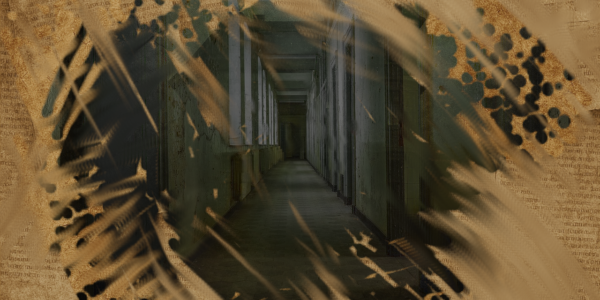
I’ve long been interested in the potential of designing fear without ghosts. We all know that the most terrifying ghosts are not the ones we see, they are the ones that might be there, somewhere, in the darkness. In this blog, we have spoken, many time about t fear not being in the jump scare; it’s more insidious that that, fear lurks in the silent, persistent…maybe. So we have to keep on asking ourselves, what if an environment could feel haunted without us ever seeing a ghost? And what does it mean to design fear that never actualizes?
My Personal Stake
I think of myself, these days at least, as a supernatural horror academic, as such, I have found myself desperately searching for ‘what makes a haunting’ and come to the conclusion that is is in the space itself that ghosts reside and are given existence, its led to a deep interest in architectural unease, and I find myself captivated by the concept of ghosts as a kind of structural logic, a spectral layer within systems themselves. This question has haunted my creative and theoretical practice for a time now and, this week I want to share some of these, quite abstract concepts and look at the idea and opportunities for us when designing fear without ghosts.
Systemic Hauntings: Presence Without Manifestation
The term, Hauntology, was introduced by Derrida (1994), and, ironically, has little to do with ghosts as we understand them. But it also helps us understand the concept of ‘presence through absence’. A ghost does not need to materialize to be real, anyone who has been awake in the dark at some ungodly hour knows that! Existence, is both optional and unnecessary if we are talking about ghosts, it need only threaten to appear to us to frighten us. Derrida’s Specter “neither present nor absent, neither dead nor alive” becomes a powerful metaphor for atmospheric ambiguity. Freud’s (1919) concept of the uncanny helps us understand this more deeply: the uncanny forces us to consider the familiar rendered strange through subtle dissonance. In design terms, what this means is that we can embed systems that hint at more than they reveal, it gives us, and expects of us the opportunity to create spaces that feel populated by absence itself. An architectural layout, a pattern of flickering lights, or a subtle repetition can do more to summon dread than any apparition we can create.
Potential Over Actual: The Liminal System
We can draw on Aristotle’s distinction between potentiality and actuality to frame haunted design as a system saturated with unrealised capacity when considering methods for designing fear without ghosts. The ghost that could or ‘might’ appear is ontologically real even if it never appears to us. Deleuze (1994) extends this concept of ‘potential’ through his notion of the virtual, seeing the virtual as something fully real, though not yet actualized. The true presence of potential destabilizes certainty it injects the potential, the threat even, of ‘possibly’. It creates a state of interpretive suspension which echoes Keats’ idea of negative capability: the ability to remain in “uncertainties, mysteries, doubts” without resolution. The beauty of this is the limited technical requirement to create mechanics that extend beyond the expectations of the participant, in such systems, fear arises not from scripted events but from the tensions between what is and what might be.
Ambiguity as Method: The Sublime of Indeterminacy
Todorov (1975) describes the fantastic as a moment of hesitation between natural and supernatural explanations. In this hesitation we can find the aesthetic mode of haunted systems. By refusing to confirm the origin of the fear we feel, these designs position players in a liminal space, not just in setting, but in cognition. The resulting lingering unease resists true escape. Echoing the sublime as theorized by Burke (1757) and Kant (1790), this mode creates fear, not through confrontation, but through vastness, uncertainty, and the inability to fully grasp the why we feel uneasy. It’s not the ghost that terrifies, but the thought that it might have been one.
Conclusion: Fear as a State of Possibility
The more I work in the realm, the more I realise that the most profound hauntings emerge from what is implied and left unresolved rather than from the things we see. When game spaces are designed to harbour possibility without confirmation, fear can become a state of mind rather than a reaction. Ambiguity, potentiality, and emergence converge to form an experiential logic in which players do not simply observers of fear, they become participants in its construction. In such game worlds, the supernatural is not a narrative device, it is a metaphysical condition. The design whispers: they might be here, and that is enough.
References
Aristotle. (1984). Metaphysics (Book Θ). In J. Barnes (Ed.), The Complete Works of Aristotle. Princeton University Press.
Derrida, J. (1994). Specters of Marx. Routledge.
Deleuze, G. (1994). Difference and Repetition. Columbia University Press.
Freud, S. (1919). The Uncanny.
Todorov, T. (1975). The Fantastic. Cornell University Press.
Keats, J. (1817). Letter to George and Tom Keats, December 1817. (On Negative Capability).
Burke, E. (1757). A Philosophical Enquiry into the Origin of Our Ideas of the Sublime and Beautiful.
Kant, I. (1790). Critique of Judgment.