Introduction
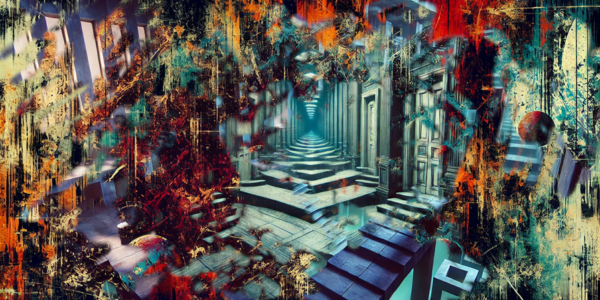
Horror games thrive on subverting expectations, unsettling players by disrupting their sense of control and security. However, when the environment itself becomes the antagonist, fear reaches an entirely new level. Non-Euclidean horror spaces—environments that defy conventional geometry—are a powerful tool for crafting immersive, mind-bending terror (Osudin, Denisova, & Child, 2024). By manipulating space in unpredictable ways, these environments create cognitive dissonance, forcing players to question their surroundings and increasing psychological distress (Wiggins, 2024). This technique enhances horror by transforming game worlds into shifting, disorienting nightmares.
Defining Non-Euclidean Spaces
Traditional geometry follows predictable rules: straight lines remain straight, distances are consistent, and spatial orientation is stable. Non-Euclidean spaces violate these principles, resulting in paradoxical and disorienting environments (Pascua et al., 2023). These elements are commonly seen in horror games, where they intensify feelings of unease.
Looping Hallways: Paths that lead players back to the same location, disrupting expectations of movement and progression.
Impossible Doorways: Connections between rooms that defy spatial logic, creating a sense of entrapment.
Shifting Distances: Corridors that stretch, compress, or change unexpectedly, distorting perception.
Warped Perspectives: Rooms that appear normal but contain impossible spatial configurations.
These manipulations force players to experience cognitive dissonance, inducing paranoia and unease (Howard, 2017). The spaces become dynamic, deceptive entities rather than passive backdrops.
How Non-Euclidean Horror Spaces Affect the Player’s Mind.
The psychological impact of non-Euclidean horror spaces is profound. By removing predictability, these environments trigger confusion, anxiety, and fear. Several key psychological mechanisms explain their unsettling effect:
1. Destroying Predictability
Our brains seek patterns and consistency in our surroundings. When these expectations are shattered, cognitive stability is lost. This concept aligns with Freud’s “uncanny,” where the familiar becomes disturbingly unfamiliar (Kirkland, 2009). As players struggle to make sense of shifting environments, they experience a unique form of horror.
2. Stripping Away Control
One of the most effective horror techniques is removing player agency. When environments change unexpectedly, players lose their sense of control (Barrack, 2022). This unpredictability mirrors the psychological unease caused by liminal spaces, which exist in a state of transition and evoke discomfort (Wiggins, 2024).
3. Manifesting the Uncanny
The uncanny valley concept is often applied to human-like figures but can also apply to game environments (Howard, 2017). When a hallway stretches subtly or a door leads somewhere impossible, players feel something is “off” but cannot immediately identify why—intensifying fear.
These design choices make environments feel alive, unpredictable, and deeply unsettling.
4. Cognitive Overload and Dissociation
Our brains constantly search for recognizable patterns. In non-Euclidean horror spaces, this effort becomes exhausting, leading to apophenia—the perception of patterns where none exist (Williams, 2017). The mental fatigue caused by navigating unreliable spaces enhances feelings of psychological entrapment (Lam, 2024).
Case Studies in Non-Euclidean Horror
Case Studies: Non-Euclidean Horror in Games
Several games have masterfully implemented non-Euclidean horror spaces, using impossible geometry to enhance fear.
1. P.T. (Silent Hills Playable Teaser)
P.T. is one of the most iconic examples of non-Euclidean horror. Its looping hallway creates an endless cycle of paranoia and psychological torment. Subtle environmental changes intensify unease, making players feel trapped in a shifting nightmare (Barrack, 2022).
2. Antichamber
Though not a horror game, Antichamber effectively uses non-Euclidean space to unsettle players. Rooms shift dynamically based on movement and perspective, reinforcing the idea that reality cannot be trusted (Pascua et al., 2023).
3. The Stanley Parable
This game blends humour with surreal horror by using unpredictable spatial shifts. The architectural inconsistencies induce discomfort, mirroring the cognitive disruption seen in horror games (Barrack, 2022).
4. Control
Control’s Oldest House exemplifies architectural horror. Hallways stretch, rooms fold into themselves, and the environment constantly shifts, mirroring the eerie unpredictability of liminal spaces (Wiggins, 2024).
The Future of Non-Euclidean Horror in Games
As gaming technology evolves, the potential for non-Euclidean horror spaces grows exponentially. Advanced physics engines now allow for more sophisticated manipulations of space. Research into hyperbolic and spherical geometry suggests even more intricate ways to distort player perception (Osudin, Denisova, & Child, 2024). Additionally, procedural generation may enable environments to shift dynamically based on player actions, ensuring no two playthroughs are identical (Williams, 2017).
With these advancements, horror games can become even more immersive, using non-Euclidean environments to push psychological horror to its limits.
Conclusion
Non-Euclidean horror spaces are among the most effective tools for creating psychological terror in video games. By disrupting fundamental expectations of space and movement, they turn navigation itself into a source of fear. These environments challenge perception, strip players of control, and induce a deep sense of unease. As game design evolves, non-Euclidean horror is set to play an even greater role in shaping the future of interactive horror.
References
Barrack, A. (2022). Hitting a Little Too Close to Home: Reflexivity, Liminality, and Identification in Horror across Film, Theatre, and Games. University of Central Florida.
Howard, M. C. (2017). Investigating the Simulation Elements of Environment and Control: Extending the Uncanny Valley Theory to Simulations. Computers & Education, 109, 216-232.
Kirkland, E. (2009). Horror Videogames and the Uncanny. DiGRA.
Lam, C. (2024). The Simulated Weird: Video Games, Weird Fiction, and Gothic Horror. University of Otago.
Osudin, D., Denisova, A., & Child, C. (2024). Non-Euclidean Video Games: Exploring Player Perceptions and Experiences inside Impossible Spaces. IEEE Transactions on Games.
Pascua, C., Datu, W. H., Dela Peña, J. C., & Ocampo, B. B. (2023). Illusory: A Non-Euclidean Concept Adoption in a 3D Puzzle Game. ACM International Conference on Computer and Communications Management.
Wiggins, B. E. (2024). The Backrooms and Liminal Spaces: Explorations of a Digital Urban Legend. New Media & Society.