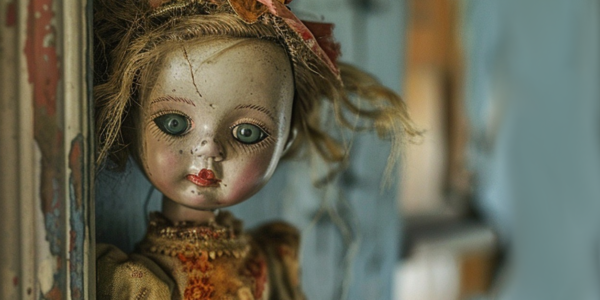
In horror game design, the familiar can become the unexpected, as everyday when items are subtly twisted or used out of context to provoke unease. This unsettling effect is grounded, again, in the psychological concept of the uncanny, where the familiar become hauntingly strange (Virno & Ricciardi, 2005; Freud, 1919). By altering an object’s placement, context, or appearance, designers can tap into deep-seated anxieties and craft environments that blur the line between ordinary and ominous.
The Uncanny in Horror
We have spoken time, and time again about the uncanny. According to Freud’s theory, fear emerges from familiarity when it becomes oddly distorted, disrupting the viewer’s expectations (Freud, 1919; Virno & Ricciardi, 2005). The effect is pivotal in horror, items like mirrors, children’s toys, and clocks can take on sinister associations through slight modifications (Dodds, 2009). When an everyday object, such as a child’s doll, becomes associated with menace, the sense of safety tied to the object is undermined (Fu, 2016).
Role of Placement in Horror
The placement of objects can evoke discomfort by disrupting expected spatial relationships. A familiar item in an unusual location, such as a television set in a forest or a toy in an adult environment, creates a sense of absurdity which highlights the object’s horror potential (Gaut, 1993; Dodds, 2009). According to Carroll’s 1977 horror theory (2003), unexpected settings enhance tension by challenging the viewer’s sense of spatial order (Gaut, 1993). In the same way, the isolation of a single object, like a pair of shoes on a staircase, draws the viewer’s attention, imbuing the ordinary with mystery and fear (Virno & Ricciardi, 2005).
Isolation and Fear
Loneliness can also be conveyed through isolated objects that intensifies horror by suggesting abandonment. Dodds (2009) explains how isolated objects, such as a lone plate in a deserted dining room, evoke abandonment and heighten the viewer’s feelings of vulnerability. The isolation of objects creates an unsettling focus and triggers viewers to imagine unseen presences. This technique aligns with psychoanalytic aesthetics, as loneliness and isolation can trigger subconscious fears (Dodds, 2009).
Context as a Psychological Tool
Context is also a powerful tool, an item’s context, for example, when the object is aged or decayed, the object itself can create a haunting atmosphere. Objects marked by decay, such as a child’s doll with a missing eye or an old deteriorating photo, often suggest violence or abandonment, prompting the viewer to question or imagine an unseen backstory (Dodds, 2009). This decay evokes deep societal fears linked to our own fears of aging and mortality, echoing themes in horror cinema where decay suggests deeper existential threats (Gaut, 1993).
Sound and Psychological Horror
Sound also plays a critical role in transforming ordinary objects into horror. Dodds (2009) highlights that sound associated with specific objects, such as a ticking clock or creaking floorboards, can heighten unease by adding an auditory dimension to visual fear. Fu’s (2016) work further emphasizes that horror films frequently use sound to manipulate time and space, with sounds that do not match the object’s visual state adding an eerie, supernatural layer.
Mirrors and Reflections
Mirrors have long been a staple in horror and are used to symbolize introspection and self-confrontation, they can serve as portals to the unknown. Freud’s exploration of the uncanny (1919) applies here, as reflections present an altered, potentially malevolent image of reality. This symbolic distortion allows mirrors to be seen as gateways into the unknown, playing on the viewer’s latent fears about identity and the unknown (Virno & Ricciardi, 2005).
Conclusion
The transformation of ordinary objects into elements of horror relies on subtle adjustments that heighten psychological discomfort. By altering the placement, isolation, and context of familiar items, horror designers can evoke primal fears tied to loneliness, decay, and the uncanny (Gaut, 1993; Dodds, 2009). This approach taps into universal anxieties, making even the mundane a source of terror. In doing so, horror game designers can blur the line between the familiar and the strange, illustrating the unique power of everyday objects to evoke fear.
References
- Carroll, Noël. The philosophy of horror: Or, paradoxes of the heart. Routledge, 2003.
- Dodds, J. (2009). The Monstrous Brain: A Neuropsychoanalytic Aesthetics of Horror?. University of New York in Prague.
- Freud, S. (1919). The Uncanny. Penguin.
- Fu, X. (2016). Horror Movie Aesthetics. Thesis, Northeastern University.
- Gaut, B. (1993). The Paradox of Horror. British Journal of Aesthetics, 33(4), pp. 333-337.
- Virno, P., & Ricciardi, A. (2005). Familiar Horror. Grey Room, 21, pp. 13-16.
One response to “Transforming Everyday Objects into Horror”
[…] Transforming Everyday Objects into Horror […]